Open research · photonic computing
TimeLightHub
A Composable Photonic Computer That Thinks in Light
Corrections, October 2026
An internal technical review of the published record (version 1.0, September 2026) found statements that go beyond the evidence. They are listed under Corrections below, and a corrected version 2 of the papers is in preparation. The text on this page is the corrected description.
Summary. TimeLightHub is a proposal for a photonic computing architecture for AI inference in which a model's weights are stored in a non-volatile photochromic material and stay in place while light passes through them. The memory element, a diarylethene whose refractive index differs between two stable forms and is read away from its absorption bands, is established science demonstrated by others (Ebisawa et al., 1994; Bilodeau et al., Optica, 2024). The contribution proposed here is an architecture around it: a hexagonal fabric of composable elements, a weights-in-place matrix-multiply cell, path-matched optical clocking and several new element geometries. Nothing has been built by us. The published record also describes all-optical logic, an optical lookup (the "OmniCube"), passive signal restoration and majority voting. These have no demonstrated physical mechanism yet and should be read as long-term ideas.
What is proposed
- Non-volatile photonic weights. A photochromic layer holds a value with the power off. The physics is not ours; our proposal is its use as a composable element of an inference engine. It suits values that are written rarely and read often.
- Weights that stay in place. Light is multiplied by the stored weights as it passes, and a detector reads the sum. This is an active research direction, so far mostly with phase-change materials. Whether a photochromic version gives an energy advantage is a hypothesis to be measured, not a result.
- New element geometries. Four designs are described in the patent application and are not yet published.
- Conceptual, not yet supported by a mechanism: all-optical logic gates, the optical lookup, passive signal restoration, optical majority voting, and the LUMINA language, which is at design stage.
The thirteen elements of version 1.0
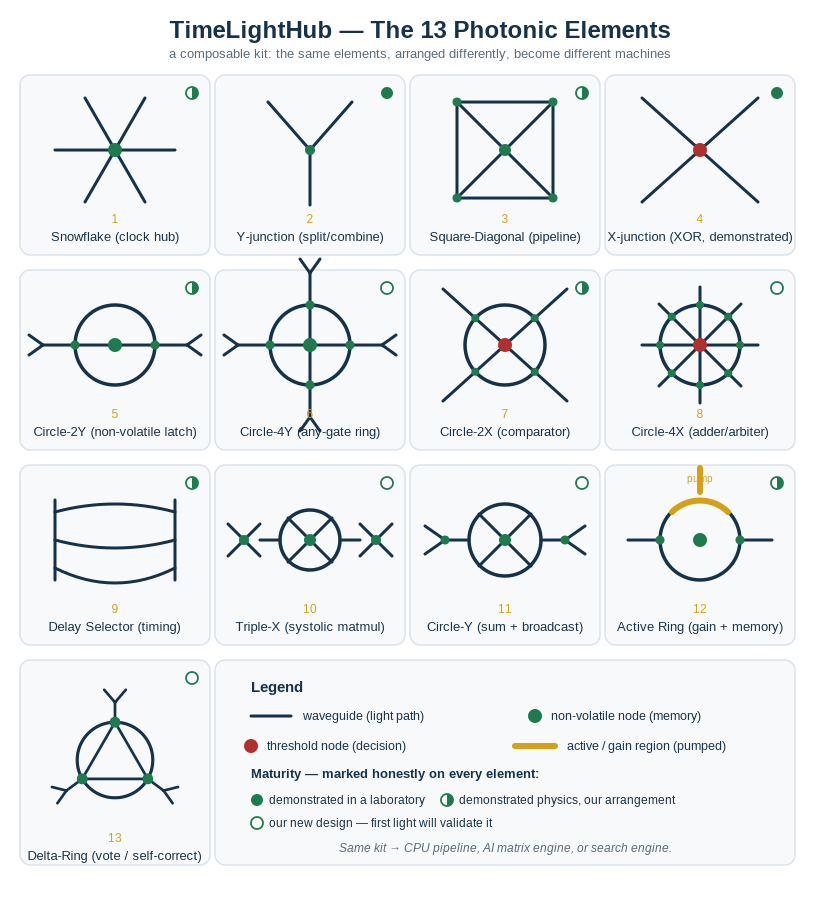
Status
Nothing has been built and no measurement of ours exists. The energy advantage is a hypothesis: it depends on the energy to read one stored weight, counted with lasers, detectors and electronics, and on how many weights share one detector. Complete photonic processors published so far operate near one picojoule per operation, and the best electronic in-memory chips below that. The statement in version 1.0 that published physics already places the read energy in the winning range is withdrawn. The project's simulator is a system-level bookkeeping model with assumed inputs, not a physical simulation of the memory cell.
The first experiment (protocol version 1.1)
One diarylethene cell in a polymer host: write near 375 nm · reset 532 nm · read off resonance through the refractive-index difference between the two forms. Three measurements: readout latency, energy per read stated at the detector, launched and wall-plug, and read-disturb per unit of probe dose.
Version 1.0 specified a 405 nm read and called it non-destructive. That was incorrect: an absorbed probe disturbs the stored state. Much of the cell physics has been shown by others. What an architecture still needs to know is the read energy with a real receiver, read-disturb under continuous use, and how many levels one cell can hold.
Looking for: a photonics or photochromic-materials laboratory interested in these measurements. Engineering notes are shared under agreement.
Corrections to version 1.0
| Statement in version 1.0 | Correction |
|---|---|
| The memory is read at 405 nm, non-destructively. | An absorbed probe disturbs the state. The read is off resonance, by refractive-index change, with read-disturb measured. |
| Published photonic physics gives tens of times less energy per answer. | A hypothesis. The energy count in version 1.0 omits lasers, detectors and converters. No published value exists for the photochromic read. |
| An independent simulator confirms the advantage across the plausible range. | Withdrawn. The simulator is the project's own bookkeeping model with assumed inputs. |
| The interference XOR gate is demonstrated in the laboratory. | The cited figures come from simulation studies. |
| Passive nodes re-clean a signal with no power. | No passive element restores a signal level. A nonlinear mechanism would have to be named and shown. |
| Interference gates compose into a processor. | Chained logic needs level restoration at every stage. Speculative until a mechanism exists. |
| The OmniCube lookup replaces arithmetic at low energy. | The lookup is named but not physically specified, and no energy advantage has been shown. |
| A computer of a few dozen parts instead of billions. | That counts kinds of element, not elements. One memory cell is needed per weight. |
| No one pairs non-volatile optical memory with a compute engine. | Incorrect. See Ríos et al. (2015), Feldmann et al. (2021) and Bilodeau et al. (2024). |
| The memory cell replaces the flip-flop and register. | Writing is slow and energy-heavy and the material tolerates a limited number of writes. It suits stored weights, not working registers. |
Papers and documents
All documents below are the public research record, released under CC BY-NC-ND 4.0. The Zenodo record is the version of record.
Version 1.0: white paper + seven technical papers, all figures. 52 pages. Identical to the Zenodo record. Read with the corrections above.
Version 1.0 as a single web page with vector figures. Read with the corrections above.
Version 1.0. The architecture in one paper. Read with the corrections above.
One page for partner laboratories: the single memory-cell experiment with the corrected read step and three measurements.
One page: why the 405 nm read was wrong, the three read regimes, read-disturb, and what read energy to expect.
Version 1.0. One page. Read with the corrections above.
| Record | Identifier | Status |
|---|---|---|
| Zenodo (version of record) | 10.5281/zenodo.22649324 (concept DOI) · v1.0 10.5281/zenodo.22649325 | Published 7 Sep 2026 |
| UK patent application | GB2615417.9 (UK Intellectual Property Office) | Filed 18 Jun 2026 · Patent Pending |
| Author | ORCID 0009-0003-8565-2605 | Samer Beyrouty |
How to cite
BibTeX:
Contact
Samer Beyrouty — Inventor & Architect, TimeLightHub
Connect@TimeLightHub.com · +961 3 097 151 · ORCID 0009-0003-8565-2605
Laboratories, foundries and research partners: an email is the easiest first step. The Phase-1 protocol and the technical addendum are public above; engineering notes are shared under agreement.